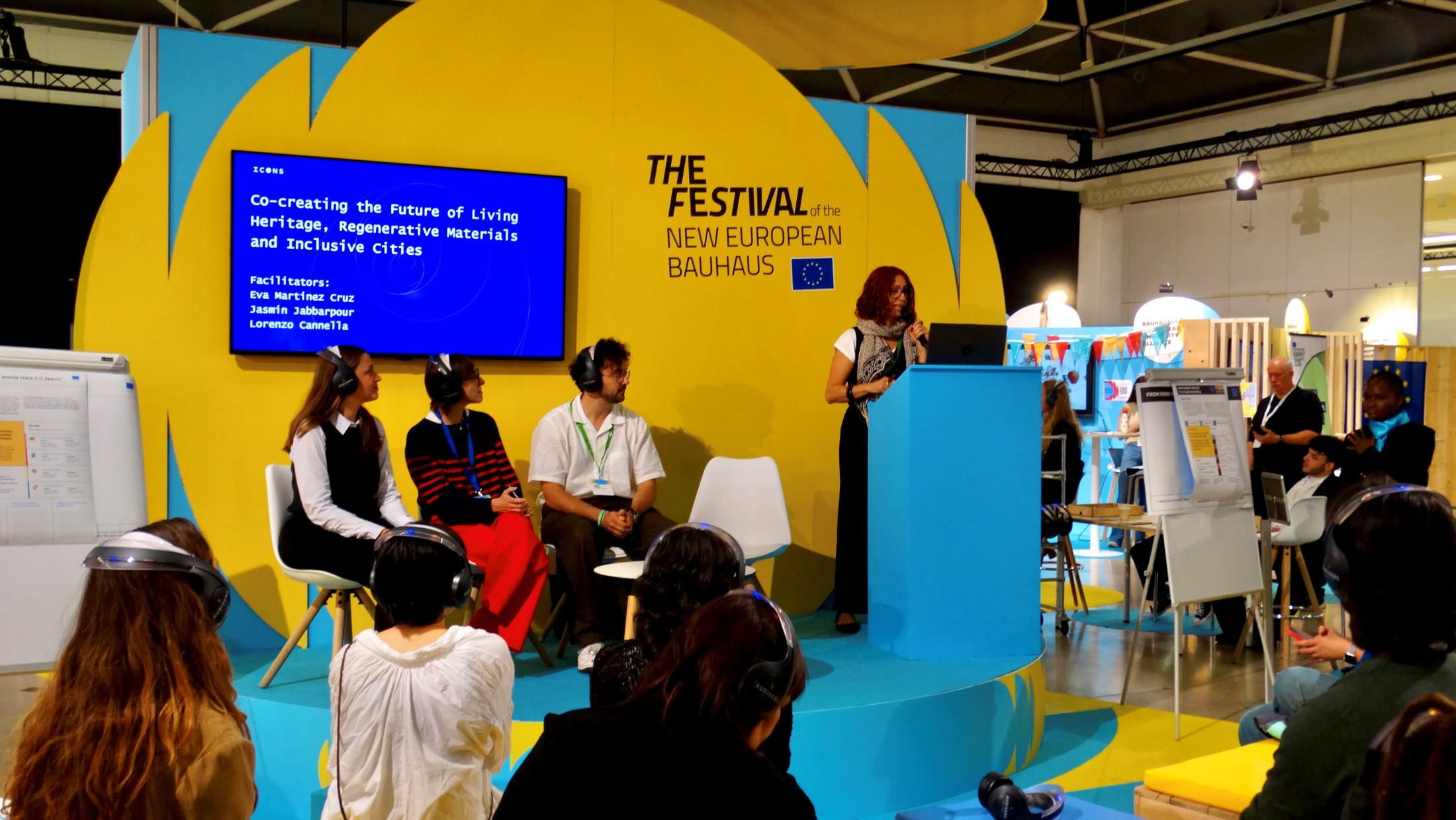
Titled “Co-creating the Future of Living Heritage, Regenerative Materials and Inclusive Cities”, the session gathered 25 participants to explore how NEB values can become practical, people-centred solutions.
Using an adapted Ikigai methodology, participants worked in multidisciplinary groups on real urban challenges – each arguing a stakeholder perspective that was not their own, as resident, public authority, developer, designer or heritage representative. The role-play surfaced trade-offs that usually stay hidden when people reason only from their own standpoint.
For EHHUR, whose work places citizens at the heart of neighbourhood transformation, the exercise confirmed a core conviction: better urban outcomes emerge when the people affected help to define the problem, not just react to a solution. Much of the value appeared before any solution was proposed, as groups collectively re-framed the challenge. The sharpest insights came from disagreement – over cost, speed, authority, and what to preserve or transform – grounding conclusions in realistic deliberation. Read together, EHHUR, TIMBERHAUS and INHERIT showed the NEB values as one interdependent system rather than three separate tracks.
Image credits: ICONS
Share the news: